
| Wednesday, April 26
By Chris Mortensen
Special to ESPN.com |
|
In his latter years as general manager of the San Diego Chargers,
Bobby Beathard chose Ryan Leaf. He traded future first-round draft picks for
a pair of marginal receivers, Bryan Still and Mikhael Ricks. He pushed Bobby
Ross out the door. He hired Kevin Gilbride. None of these facts can be
disputed.
| 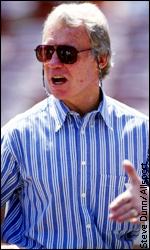 | | Bobby Beathard succumbed to pressure in drafting Ryan Leaf. |
Yet in the wake of Beathard's retirement on Tuesday, it must be said
that few, if any, front-office football men have captured the spirit of the
NFL as well this man whom, I must confess, I regard as a friend.
At the same time, let me qualify that Beathard is not a friend in the
traditional sense of the relationship. We've never been out together for
dinner. Even though we grew up near the same Southern California beaches, we
have never surfed, or even body surfed, together. I don't have his passion
for exercise, though I wish I did. (Beathard, 63, has a body most
22-year-olds would envy, let alone a 48-year-old man as myself).
We have spent numerous hours on the phone, and only half of it has
been about football. We laugh about a lot of things. We both value our
families. I like talking to Christine, his wife, almost as much as I like
conversing with Bobby. We share similar political beliefs.
Thus, it didn't surprise me when Beathard joked with a San Diego
radio station on Wednesday morning that he wouldn't have retired as the
team's general manager "if I thought Janet Reno was replacing me."
It was Beathard's way of saying that he believes he has left the
Chargers' franchise in good hands. He is convinced that Ed McGuire, the
new vice president of football operations, longtime personnel director Billy
Devaney and coach Mike Riley will take the Chargers upward from their 8-8
finish in 1999.
In Riley, he sees a man who is not just a coach-on-the-rise, but a
good and decent fellow. He saw those qualities in Joe Gibbs, an obscure NFL
assistant when Beathard stunned Redskins fans by hiring Gibbs in 1982.
This is not to say that Riley will turn out to be a Hall of Fame
coach like Gibbs. This is also not to say that Beathard's often-brilliant
career is ending on a high note.
Ryan Leaf's legacy as perhaps one of the greatest busts in draft
history has tainted Beathard's history. Anyone who knows Beathard knows that
of all his mistakes as a general manager, Leaf should be weighed as the least
of them.
Beathard totally disregarded his philosophy when he selected Leaf as
the No. 2 pick in the '98 draft following Peyton Manning. Courtesy of our ace
researcher, Russell Baxter, the books show that Beathard drafted 17
quarterbacks prior to Leaf's selection, but none in the first or second
rounds.
Beathard had seen Don Strock, a fifth-rounder with the Dolphins in
'72, become a vital quarterback on championship teams. Even though he didn't
draft Joe Theismann with the Dolphins -- Theismann was a fourth-round pick by
Miami in '71 and signed by the Redskins in '74 out of the CFL -- he witnessed
Theismann's success as a Super Bowl quarterback under Gibbs.
When Tampa Bay gave up on Doug Williams, a former No. 1 pick,
Beathard brought him in to rescue the Redskins in 1987, leading
Washington to its second Super Bowl title. Beathard took Mark Rypien in the
sixth round in '86; Rypien won a Super Bowl in '91.
Beathard also used a sixth-rounder to select Stan Humphries in '88,
his last draft with the Redskins. Humphries led the Chargers to their
unlikely Super Bowl appearance against the San Francisco 49ers, albeit it a
losing effort.
Think about this, too: Beathard selected Indiana quarterback Trent
Green in the eighth round of the '93 draft. As a St. Louis official recently
noted, it could have been Green, not Kurt Warner, who led the the Rams to
their Super Bowl title had Green not suffered a major knee injury late in the
'99 preseason.
|
“ |
Beathard would have chosen Manning
over Leaf had the Chargers owned the No. 1 pick;
Colts president Bill Polian would have accepted
Leaf had he been in Beathard's No. 2 shoes. So
would have 98 percent of the NFL's other
personnel men. ” |
|
|
|
That's why Beathard was so excited when he chose Florida A&M
quarterback Ja Juan Seider in the sixth round of his last draft. "He might be
the best passer in this draft," said Beathard. Typically, he doesn't care if
others degrade the choice of Seider.
Beathard felt compelled to guarantee himself a shot at Manning or
Leaf in the '98 draft because Humphries' career was finished because of
concussions, and the San Diego market, not to mention owner Alex Spanos, was
screaming for a "franchise quarterback."
Beathard may have ignored some warning signals on Leaf, but he was
also misled by Washington State coach Mike Price about the quarterback's
level of maturity. Neverthless, based on what he told me in confidence prior
to that '98 draft, Beathard would have chosen Manning over Leaf had the
Chargers owned the No. 1 pick; Colts president Bill Polian would have
accepted Leaf had he been in Beathard's No. 2 shoes. So would have 98 percent
of the NFL's other personnel men.
Even Tuesday, Beathard took a phone call from Raiders boss Al Davis,
who told him not to worry about Leaf's apparent bust. Davis told Beathard
that his football people who observed Leaf in training camp scrimmages two
years ago against the 49ers saw "another Dan Marino."
Beathard still has a good enough sense of humor to laugh about those
comparisons now. Marino didn't just have the arm; he had the toughness and
competitive drive that Leaf can't even dream about.
Beathard says the controversy over Leaf isn't what's driving him from
the game. He seeks more freedom, more time with Christine, more time with his
13 grandchildren.
Nevertheless, something tells me that the experience of Leaf's
totally irresponsible and rebellious behavior was a punctuation mark to
everything that Beathard loathes about the NFL in the year 2000.
It's not the same league that Beathard relished. There's plenty of
good parts left, but it's also about the Ryan Leafs, the salary cap, agents,
and a win-now mentality among owners and fans driven by sports-talk radio, TV
stations and internet sites multiplying like rabbits.
It used to be a sport where scouts had to work like crazy to discover
players, who were given the time to develop behind a stable coaching staff
that never split up. It's pretty appropriate that Beathard will be used as a
part-time scout by the Chargers, now left to do only what he truly loves.
Beathard's record shows that he had a hand in seven teams that
reached the Super Bowl with the Dolphins, Redskins and Chargers. Four of
those teams won Super Bowls, and he gained his reputation as "the smartest
man in football," a title that embarrassed him.
By stepping aside in this most timely moment, Beathard may have
validated that notion again.
Keyshawn to join Bucs' block party
Naturally, Keyshawn Johnson was the attraction at the recent minicamp
of the Tampa Bay Buccaneers, but the significance for players was the
unveiling of new offensive coordinator Les Steckel's scheme.
It was apparent that the Bucs' offense -- while infused by Johnson's
presence as a Pro Bowl receiver -- will still revolve around the backfield
tandem of Mike Alstott and Warrick Dunn.
| |  | |
| Alstott |
Steckel is seeking to utilize Alstott's physical prowess in different
ways. He will still have some moments as a carrier in a one-back set. But
he'll also work out of the H-back position (a hybrid tight end-fullback
role) and will be given a chance to work as a receiver as Frank Wycheck did
for Steckel in Tennessee.
"We've got to find different ways to get Mike the ball in open space,
so that's what Les is trying to accomplish," said Bucs coach Tony Dungy.
Alstott also will likely do more blocking in a classic fullback role,
hoping to spring Dunn for some big gains. Here, Steckel will also try to take
advantage of the Bucs' athleticism along the offensive line with two big
free-agent acquisitions off the Vikings roster, center Jeff Christy and guard
Randall McDaniel.
Christy and McDaniel both move well enough to be able to pull as
blockers for Dunn outside.
"Plus, (right guard) Frank Middleton and (left tackle) Jason Odom are
pretty athletic, too," said Dungy. "We want Warrick to be able to attack any
hole on the field."
Don't forget Johnson's prowess as a blocker. Dungy and Steckel know
that they just didn't get a receiver who is content only if he is catching
the football. Johnson readily answered ex-Jets coach Bill Parcells' call to
be the crack-down blocker who often springed Curtis Martin on long runs.
"We know exactly what we've got with Keyshawn," said Dungy.
The greatest question for the Bucs remains at quarterback. Steckel
has re-created some of the same plays for Shaun King that he did for the
Titans' Steve McNair. King will work more out of the shotgun and benefit from
some moving-pocket formations. King doesn't have McNair's physical prowess,
so he's likely to work even more frequently from these sets.
Still, King will be under center plenty -- one of his main tasks
still will be to hand the football to Alstott and Dunn. |  |












