
| Thursday, April 6
By Chris Mortensen
Special to ESPN.com |
|
Dennis Green didn't look like a worried man when he strolled the halls of
The Breakers Hotel at the recent NFL meetings in Palm Beach, Fla. Now that
one thinks of it, Green seldom looks like a man being led to the
plank. Perhaps, just perhaps, it is because Green appears to be leading
himself to his own doom as coach of the Minnesota Vikings.
| 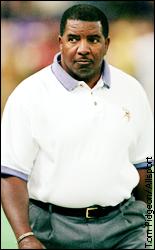 | | Dennis Green has led the Vikings to a 3-7 playoff record in eight seasons. |
Those who follow the Vikings in Minnesota assume that Green's oblivion to
this offseason of turnover is either a symptom of ignorance or arrogance, the
latter of the two the most likely explanation. Make no mistake, this is a man
sure of himself -- or full of himself.
Green is either going to be the first coach fired this year or he'll be
the coach of the year.
Although Green's leadership has always been evident, there has been no
mistaking his control of the Vikings' ship ever since owner Red
McCombs fired vice president Jeff Diamond shortly after Diamond was voted the
NFL's executive of the year in 1999.
In a way, that makes McCombs' job easier as he assesses his team. One man
is truly accountable for the success or failure of the Vikings. It's Green.
For a team that has been on the brink of a Super Bowl appearance for two
straight years, the Vikings' upheaval this offseason has been one of the
NFL's most demanding stories. Green's behavior has stunned even his most
ardent admirers.
It started in late January when on a Monday evening in Mobile, Ala.,
while scouting the Senior Bowl, Green told his entire staff of assistants
that he saw no real changes in their job status.
Within 48 hours, linebacker coach Tom Olivadotti was fired without
Green first consulting defensive coordinator Foge Fazio. That pushed Fazio to jump
ship to join the Washington Redskins for lesser responsibility (linebacker
coach) but more money.
Next thing you know, offensive coordinator Ray Sherman, whose unit surged
when Jeff George replaced Randall Cunningham as quarterback, was asked to
accept a demotion to receivers coach in order to make room for ex-Packers
offensive coordinator Sherman Lewis. Sherman rightfully refused.
While Green defended his actions by heaping praise on Lewis and wanting
to improve team chemistry, it also was a veiled statement that George's
seemingly sparkling comeback as an NFL quarterback in 1999 had not sold
Green. Ray Sherman was a Jeff George guy.
Green apparently believed that Cunningham would take a pay cut to return as a one-year starter for the 2000 season. Cunningham balked, a decision made easier by the fact that the Vikings paid him a $1 million bonus on March 1. Now, they look like they will cut him on June 1.
Players and coaches have always described Green as a terrific salesman. Now his persuasive powers have waned in the face of a tightened salary-cap belt, which was caused by Green's penchant for offensive firepower.
Not only has he lost two veterans quarterbacks in George and Cunningham
-- whose combined regular-season record is 22-4 over the past two seasons --
but he watched two Pro Bowl linemen, center Jeff Christy and guard Randall
McDaniel, bolt the team as free agents to sign with none other than the
Vikings' NFC Central rival, the Tampa Bay Buccaneers.
|
|
Players and coaches have always
described Green as a terrific salesman. Now his
persuasive powers have waned in the face of a
tightened salary-cap belt, which was caused by
Green's penchant for offensive firepower. |
|
|
|
Veteran receiver Jake Reed and tight end Andrew Glover are now playing
for the New Orleans Saints, and the team's best cornerback, Jimmy Hitchcock, is gone.
Now, is this really a disaster?
Christy and McDaniel may have been Pro Bowl players, but they also may
have been overpriced. Christy's leadership may be missed more than McDaniel's
presence, but Christy is also not a dominant center, just a savvy one.
McDaniel may be a future Hall of Famer, but his play was spotty
in 1999, based on the assessment of league personnel men.
Reed has shown signs of age, and Glover gave only glimpses of potential,
which he never quite fulfilled. Hitchcock performed well, but he was hardly a
Pro Bowl player.
Green still has Cris Carter, Randy Moss and Robert Smith -- which is
arguably the best receiver-running back combo in the NFL. He still has a
solid pair of bookend tackles in Korey Stringer and Todd Steussie.
On defense, there's defensive tackle John Randle and linebackers Dwayne Rudd and Ed McDaniel, and strong safety Robert Griffith, one of the most
underrated players in the league.
But that's about it, and the capable Emmitt Thomas, who replaced Fazio as
defensive coordinator, will have to do his best work. Like Fazio, Thomas must live with Green's overall neglect of the defense over the years.
No decision could be more symbolic of the state of the Vikings than
Green's decision on draft day a year ago.
With the 11th pick, Green was staring at two obvious choices: Florida
defensive end Jevon Kearse or Central Florida quarterback Daunte Culpepper.
Green has had his draft moments, the most obvious being when he
pulled the trigger on Moss, who had dropped to Minnesota's 21st slot in 1998.
But 1999 was not one of those moments. Kearse never should have slipped to No. 11. The Vikings had a glaring need at defensive end, and a team that was
within a field goal of the Super Bowl seemingly could have crossed that bridge with
a first-class pass rusher such as Kearse. Green ignored those factors and
selected Culpepper, figuring that Cunningham was in his twilight years, and
Brad Johnson had been traded to the Redskins. Green then reached for his defensive end answer by using his second first-round pick on Dimitrius Underwood, the oft-troubled player now trying to make it in Dallas.
Kearse became a Pro Bowl player as a rookie for the Tennessee Titans, who
reached the Super Bowl, and is arguably one of the greatest impact defensive
players the league has seen since Lawrence Taylor. Culpepper was so
unimpressive as a rookie in training camp that many Minnesota players, such
as Reed, wonder whether he's going to be a factor.
He'll be a factor, all right. Cunningham is out. Dan Marino wouldn't take the bait as a one-year fix. George wouldn't accept a take-it-or-leave-it deal. Rick Mirer was Green's "ace in the hole," much to the dismay of Vikings' fans, but even Mirer could not say "I do."
That leaves the Vikings with Culpepper as the designated starter, with
Bubby Brister as the backup-in-waiting. I think I heard a few executives and coaches in the NFC Central breathe a collective sign of relief Wednesday when Brister accepted a one-year contract for $500,000.
Green has been a staple in Minnesota. His teams have reached the playoffs
in all but one of his nine years as the Vikings coach. He is a prominent face
and voice in the league. Many people have predicted his demise as he has
survived many a storm.
Yet, as one prominent team executive said while strolling the same halls
as Green at the league meetings last week, "The Vikings have all the signs of
a sinking ship." And the captain always goes down with the ship. |  |












