|
|
|
Friday, November 3, 2000
Holdouts could hurt Boston ... again
By Nancy Marrapese-Burrell
Special to ESPN.com
|
If you keep your ears wide open and lean toward the East, the sound you
hear in Boston is one of deafening silence.
Despite the fact the Bruins signed unrestricted free-agent defenseman
Paul Coffey to help shore up their blueline corps, there is absolutely
nothing doing in Boston or pretty much anywhere else with regard to Group II
(restricted) free agents.
The change in tide has been evident the last couple of years, with clubs
across the National Hockey League taking a much harder line than they've done
in the past. In Canada, the stance has been one tied to fiscal survival. In
Boston, the line they've taken has always been one of cast iron and
represents a long-standing philosophy of fiscal restraint.
| 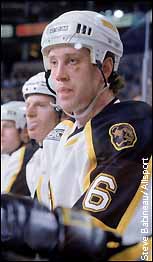 | | If Joe Thornton and others hold out, the Bruins will be in big trouble. |
Like the way president/general manager Harry Sinden and owner Jeremy
Jacobs do business or not, Sinden is nothing if not consistent in his
position.
That is what makes this summer in Beantown that much more interesting
than in the recent past.
The last time the club missed the playoffs, it was 1997, and it was the
first time Boston failed to qualify for the postseason in 30 years. The
Bruins, amid great fanfare, hired coach Pat Burns and chose center Joe
Thornton with the No. 1 pick overall and followed that up with the selection
of Sergei Samsonov at No. 8. Thornton's development was slow out of the gate,
with Samsonov going on to win the Calder Trophy as the rookie of the year,
but he and the rest of the young Bruins had the makings of a strong core.
Then came the summer of 1998, with holdouts galore, the longest of which
was right wing Anson Carter. It took until November to get ironed out and it
took Carter, as is true with all players who miss training camp, a while to
get going.
Last summer, it was goalie Byron Dafoe who decided against filing for
arbitration, setting the stage for a long holdout. Dafoe, who received
horrendous advice about sitting out rather than settling for a reasonable deal,
finally made it back to the team. But he, too, suffered greatly by missing
camp, had a rough season along with the rest of the squad and wound up
injured in February, knocking him out for the rest of the year. Jason Allison
and Carter also missed a great deal of time because of injuries that required
surgery.
In addition, Kyle McLaren, Shawn Bates, Darren Van Impe
and Thornton all had either gone under the knife or were about to by season's end.
That brings us to this offseason which has been so far -- the Coffey and Don
Sweeney signings notwithstanding -- uneneventful. And if recent history
is any indication, that is not a good sign.
After the '97 draft, Sinden made it clear he wouldn't haggle excessively
with Mike Barnett, the agent for Thornton. It was evident the Bruins wanted
to get fans and the public excited about a new course. The Bruins were full
of good will, knowing they had to be overly generous which resulted in both
Thornton and Samsonov receiving generous bonus packages. With the respected
Burns in place and by signing players, the club looked as if it was about to
embark on a rebuilding project that would pay dividends in a couple of years.
Last season set that entire plan back dramatically.
Partly because of Dafoe's
absence and partly because of the Bruins' dreadful team defense, the club
started off 0-5-4. Their fortunes turned around for a time in
November but from there, it was one disaster and injury after another.
What makes this offseason different than the one in '97, when the Bruins
were courting the good will of the fans and starting a rebuilding project, is
that no one in the organization expected this team to be where it is. Their
season ended on April 9 -- nearly four months ago -- and from that point on,
there have been discussions about whether to retain Burns (they did), and how
to change their style from boring and tentative to uptempo (hello, Mr.
Coffey).
But, getting back to the Group II situation, with the Bruins having sat
out the postseason, it begs the question -- how much is your performance
worth? Do your demands change given the fact the team's fortunes were awful?
"That was always a huge factor in contract negotiations, what kind of a
year the team had," said Sinden recently. "If you were on a losing team,
you never had a chance. They don't seem to figure that's a factor anymore.
They never figure they had anything to do with the team losing. I'm not
saying I'd be different."
Carter, who elected not to file for arbitration and set the stage for a
holdout a la Dafoe last year, is guaranteed to be the toughest negotiation
the Bruins will have this year. The player has already said he expected to be
traded at the draft, and it's abundantly clear the sides are very much in
disagreement over Carter's worth.
The Bruins' view is that they'll assess the comparables and try to sign
Carter based on what they believe an arbitrator would give him had he gone to
arbitration. Carter's view of himself is that he's worth a whole lot more
than the team is willing to pay him. The gulf is far deeper than it was in
'98 and will likely result in what Carter predicted a few weeks ago -- that he
will be traded.
"The idea here is to not get him cheap, and I would hope they wouldn't
want to take advantage of the situation and get overpaid," said Sinden. "That's really what it's all about."
Only one Bruin eligible to file for arbitration did --- goalie John
Grahame, who split last year between Providence and Boston. Grahame could
certainly sign before his hearing next month. Considering the others, Grahame
stands to be easy.
Thornton, Samsonov and most of all, Carter, stand to be toughies.
Check back here a month from now. It's entirely possible that everything said above will be exactly the same.
Nancy Marrapese-Burrell of the Boston Globe writes a weekly national NHL column for ESPN.com.
|
|
ALSO SEE
Holdouts restrict development, winning
|
|
