ATLANTA -- Jacksonville's ship came in Wednesday.
| 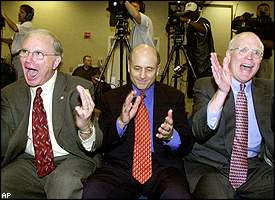 | | Jacksonville Super Bowl Host Committee members -- from left, Tom Petway, Mike Weinstein and Peter Rummell -- react to the announcement that Jacksonville will host the 2005 Super Bowl. |
With the help of some shipping companies that will bring in 10
cruise ships to help provide rooms, NFL owners voted to bring the
Super Bowl to north Florida for the first time.
Jacksonville beat out Miami, which has played host to eight
Super Bowls, in a closely contested race for the 2005 game.
As expected, the owners gave the 2004 Super Bowl to Houston and
the 2006 game to Detroit, rewarding both cities for building new
stadiums. Neither had opposition.
That wasn't the case for Jacksonville, which required four
ballots to become one of the smallest metropolitan areas to land
the biggest one-day event in American sports.
"This raises us to a first-tier city," said Wayne Weaver,
owner of the Jaguars.
Jacksonville, with a metro population just over 1 million,
earned its first Super Bowl even though the NFL had serious
concerns about a lack of hotel space and airline flights.
The city will dock at least 10 cruise ships near Alltel Stadium
on the St. John's River, adding about 8,000 rooms to its downtown
hotel capacity. Sydney used a similar tactic during the Olympics.
"I think the membership bought into that," Weaver said.
"We're going to give them a different and unique experience."
Also, three airlines agreed to triple flights to Jacksonville
during the Super Bowl week, ensuring fans will be able to get in
and out of the city.
"There was a sentiment for diversity, a change of scenery,"
said Art Modell, owner of the Baltimore Ravens. "Miami will always
be a part of the Super Bowl rotation, but Jacksonville deserved
it."
Miami brought a delegation that included former Dolphins coach
Don Shula and ex-quarterback Dan Marino.
Oakland also bid for the 2005 game but was given little chance
because of its feud with Raiders owner Al Davis. The California
city, seeking its first Super Bowl, was eliminated on the second
ballot.
Detroit's delegation was led by Mayor Dennis Archer and racing
team owner Roger Penske.
"Fortunately, a lot of the owners knew Roger Penske
personally," Archer said. "That was a nice touch."
The Super Bowl culminated a whirlwind for Penske. One Monday,
his racing team won its first CART championship since 1994.
"I told Mayor Archer that I like coming in here a winner,"
Penske said. "I guess today we're both winners."
Houston was represented by Mayor Lee Brown and Bob McNair, owner
of the Texans expansion team that will begin play in 2002.
As part of his $700 million entry fee, McNair was promised a
Super Bowl as soon as possible. It will come at the end of the
Texans' second season at their new 69,500-seat retractable roof
stadium, under construction next to the Astrodome.
Houston first played host to the Super Bowl in 1974 at Rice
Stadium. The city split with the NFL in 1996 when the Oilers left
for Tennessee, but Wednesday's decision brought the reconciliation
full circle.
"It shows the strength of the city and the resiliency of the
community to go through such a downer and turn it around in such a
short period of time," McNair said.
Detroit also is getting its second Super Bowl. The 1982 game was
played at the suburban Pontiac Silverdome.
The 2006 Super Bowl will be held at a new downtown domed
stadium, 65,000-seat Ford Field. The $315 million project is
scheduled to open in 2002, luring the Lions back to the city.
"This really speaks volumes about how the city is coming
back," Archer said, adding that he hopes the NFL's decision would
convince Major League Baseball to award an All-Star game to
Detroit.
The NFL raised some concerns about Detroit's ability to meet the
requirement for 17,500 hotel rooms within an hour drive of the
stadium. The city is counting on three casino hotels that have not
been built.
"Fortunately, we've got ample time to fill in the blanks,"
Archer said.
During their three-day meeting at a downtown Atlanta hotel, the
owners also approved a new scheduling formula when the Texans
create a 32-team league.
The league will abandon its current six-division alignment and
go to eight four-team divisions -- four in each conference.
Under the new format, each team will play six games within its
division (home-and-away against the other three teams), four games
against another division within its conference, four games against
a division in the other conference and two games within the
conference based on the previous year's standings.
Those final two games were the main sticking point, with some
owners wanting to preserve them for traditional or regional
rivalries after realignment -- Jets-Giants, Raiders-49ers,
Dolphins-Buccaneers, Chiefs-Rams and so on.
| |
ALSO SEE
Clayton: NFL owners, union extend collective bargaining agreement
NFL owners adopt scheduling format, but skirt cap issues
Clayton: Cap case will cost Niners two mid-round draft picks
|
