|
 |
|
| | Thursday, December 16 | |||||||||
ESPN | ||||||||||
AUCKLAND, New Zealand -- The most refreshing aspect of America' Cup 2000 is that good sailing is making the difference in performance.
All six of the teams that survived the three prelinary round-robins earned their spots in the semifinals through good tactics, improving on boat handling and making fine adjustments in their boatspeed. Although there were breakdowns and crew mistakes, the overall progress by the challengers is encouraging as one of them prepares for the showdown with Team New Zealand on Feb. 19, 2000.
Paul Cayard is the United States' best sailor today. His design team, led by Bruce Nelson, has done a good job. AmericaOne is the only challenger to have had the discipline not to sail its new boat, USA61, in the early round robins. If their new boat is faster than USA49, they will reach the Louis Vuitton Cup final easily.
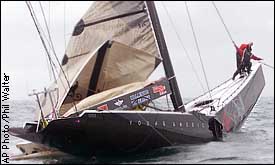
Australian skipper Peter Gilmour is ranked No. 1 in the world in match racing. He is the most aggressive helmsman on the course and protests frequently. In the early rounds this tactic did not work to his advantage as his all-Japanese crew often had trouble keeping up with Gilmour's rapid-fire tactical decisions. In the third round robin, Gilmour seemed to throttle back and the team's performance soared. Nippon's new boat, JPN52, demonstrated more speed than its first boat. Incidentally, the umpires are actually calling for penalty turn, a big departure from 1992 and 1995 when the green flag (no penalty) seemed to fly after every incident. After every race the umpires discuss their calls with a representative from each boat. I was present in New Zealand for 20 races and have watched every single race on videotape. I did not see a single missed call. Maybe the NFL could use these guys. America True Dawn Riley's America True has earned the respect of everyone in New Zealand. The team's single boat performs well in all conditions. New Zealand helmsman John Cutler also grew up on the Hauraki Gulf, but additional credit for their performance goes to American Dee Smith, who was brought on late as a strategist. Smith is to sailing like Doug Flutie is to football, simply finding a way to win. America True designer Phil Kaiko has considerable help from Heiner Meldner, who was instrumental in helping America3 with their appendage design in 1992. Riley's team is the only co-ed boat in Auckland. Prada Prada's second boat, used in Round Robin 3, did not seem as fast as ITA45, the boat it used in the first two rounds. Although they only lost one race in the early rounds, this crew's defeats to Nippon and AmericaOne in the third round robin were significant. Prada has spent more money than any other group. Having the America3 armada to trial against and a strong U.S. coaching staff has been helpful. The Italians have always folded in the past, but are working hard to change that trend. Le Defi Francais Ironically, it was the French who eliminated the New York Yacht Club's boat America II in 1986. Skipper Bertrand Pace sails with an all-French team. Their boat, Sixth Sense, started with a 2-8 record in Round Robin 1, but they improved dramatically to win seven straight races and earn a semifinals berth. Pace, like Gilmour is an extremely cagey match racer. Stars & Stripes In the last race of Round Robin 3, Dennis Conner rejoined the boat and steered around the course against the Spanish. They lost that race, but when it counted this team came through. Stars & Stripes is at her best in a strong breeze but struggles in light wind. With Ken Read, Peter Holmberg, Tom Whidden and Peter Isler in the cockpit, there is plenty of brainpower here. This team knows how to sail when behind. In Round Robin 3, the transom blew apart, but within 72 hours, they patched things back together and came out and defeated Young America in a decisive race. Many people at the New York Yacht Club would have liked to have seen Ken Read at the helm of their boat. Read, for his part, is enjoying his ride. Here's a final look at the two U.S. teams that didn't advance: Abracadabra John Kolius' Abracadabra team never seemed to get any momentum going. Lack of boatspeed, ripped sails and uneven sailing plagued this team throughout the trials. At times they won some races. For Round Robin 3, John Bertrand was added to the cockpit, but even he was unable to change Abracadabra's fortune. Kolius handed the wheel over to Chris Larson for a number of races late in the game. Larson seemed at home at the helm; we will probably see him again in Cup competition. Abracadabra spent considerable energy and resources building two boats. They might have been better off with the strategy of America True and Stars & Stripes, which both concentrated on making one boat excel. Young America Ironically, Young America chairman John Marshall lobbied hard for only four boats to be allowed in the semifinal round. As it turned out, Young America finished 7th in the 11-boat regatta. Marshall's team spent more than Stars & Stripes and America True combined, yet failed to advance. They lost for two reasons: The crew lost crucial races in Round Robin 3 and the replacement boat lacked the necessary speed. Young America never recovered from the calamity of their first boat, USA53, cracking in half. Curiously, the New York Yacht Club selected an afterguard who had little America's Cup racing experience. Skipper Ed Baird won the Laser Worlds but on the match race circuit he did not win a single event since being named skipper in 1995. Neither Baird, his tactician Tony Rey nor his navigator Ed Adams had sailed in an America's Cup campaign before. Baird was an advisor to New Zealand in 1995. But coaching and competing are two different things. Jim Brady also served in the cockpit. Brady did sail with Stars & Stripes in 1995. There will be considerable analysis by the New York syndicate for months to come. But for now Young America will be on the sideline. Young Australia and Fast 2000 from Switzerland were never in the game. The Spanish team seemed to do better with Luis Doreste at the helm; they were just short of making the semifinal. Gary Jobson is ESPN's lead sailing analyst. |  ALSO SEE It's finally official: Young America eliminated from Louis Vuitton Cup Third-round schedule and results How the competition works  | |||||||||