|
 |
|

| | Friday, April 28 Bios: Lennox Lewis, Michael Grant | ||||||||||||||||||||||||||||||||||||||||||||||||||||||||||||||||||||||||||||||||||
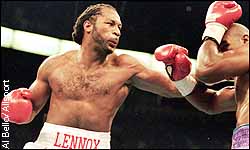
| Lennox Lewis Record: 35-1-1, 27 KOs Lewis defeated Evander Holyfield on Nov.13, 1999, for the undisputed heavyweight championship of the world. It was a rematch from their controversial draw from earlier in the year and the culmination of a long ride for Lewis, who has been overlooked for much of his strange career. The 6-5, 250-pound Lewis moved to Canada at the age of 12 and compiled a successful Canadian amateur record of 75-7 with 58 KO's. In 1983, Lewis won the gold medal at the World Junior Championships in the Dominican Republic and then climaxed his amateur career with a knockout of future heavyweight champ Riddick Bowe to capture the gold medal in the super heavyweight division for Team Canada during the 1988 Seoul Olympics.
Undefeated at 21-0, Lewis was matched against Razor Ruddock on Halloween, 1992. The winner of the bout was expected to battle the winner of the Holyfield-Bowe bout in a heavyweight elimination tournament that had been agreed upon by all four combatants. However, in boxing, things seldom work out the way they are planned. Lewis was a big underdog to Ruddock, but it didn't look that way once the fight started. After flooring Ruddock in round one, Lewis went on to drop Ruddock two more times, forcing the referee to end the bout. Lewis had seemingly assured himself of a shot at the undisputed heavyweight championship of the world.
Lewis defended his title three times, defeating a hardly menacing group of Tony Tucker, Frank Bruno and Phil Jackson. Then came Sept. 24, 1994, when journeyman Oliver McCall, in front of Lewis' hometown crowd in Wembley Arena, bombed the champ in the second round with a crushing right hand that sent him sprawling to the canvas. The fight ended there and McCall was the champ. Lewis returned to the ring with some wins over unimpressive opponents and worked his way back to contending status quickly. Lewis defeated Justin Fortune, Tommy Morrison and Ray Mercer, among others, and wanted a fight with Mike Tyson, but was refused. That vacated the WBC title yet again, and Lewis got his chance to win it back by beating his old nemesis McCall. But this one was strange. With McCall battling personal problems and actually crying during the fight and refusing to throw punches, Lewis was awarded a fifth-round technical knockout. He had the title back, but again, it was a strange way to get it.Lewis' next fight didn't earn him more fans either, though again it wasn't his fault. In July 1997, the overmatched Henry Akinwande, who got the title shot by questionable ranking, refused to stop holding Lewis. Referee Mills Lane had to warn Akinwande several times for holding and even deducted a point on one occasion; nevertheless, Akinwande refused to release Lennox and was disqualified. Lewis next destroyed Andrew Golota in one round on Oct. 4, 1997, in what may have been his finest performance as a professional. Lewis floored Golota once midway through round one with a blitzkrieg of right hands. Golota managed to climb to his feet, only to be pummeled further, forcing referee Joe Cortez to halt the bout. However, in fairness, it was easily Golota's worst performance and it was found that he had taken medicine before the fight that may have weakened him. Since then, Lewis has beaten Shannon Briggs, Zeljko Mavrovic and Holyfield twice. Lewis looked impressive in the first Holyfield fight but was only awarded with a draw. But he's the undisputed heavyweight champ until someone knocks him off.
Michael Grant
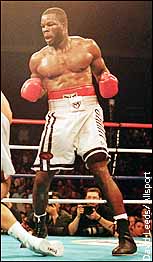
At 6-7 and 250 pounds, Grant, from Norristown, Pa., is a towering physical specimen. And for anyone who is impressed by Deion Sanders' two-sport abilities, Michael is a four-sport star in boxing, baseball, football and basketball. Born and raised on the south side of Chicago, it was in high school that Grant recognized the sports opportunities that lay in his future. Grant excelled in football, basketball and baseball in high school, where he was awarded the "Outstanding Player" award in football and basketball for the years 1990-91. His 90-plus MPH fastball earned him an invitation to try out for the Kansas City Royals, and at the same time he was being courted for a position on the football team at Southwest, but he had already accepted an offer to play defensive end and tight end at Mt. San Antonio Junior College. He then changed schools to Cal State Fullerton and changed sports to basketball, playing power forward. It was in Nov. 1992 that Grant went to Las Vegas and saw the Holyfield-Bowe fight for the heavyweight championship. After that bout and several visits to Las Vegas gyms, he decided that his future lay in boxing. Several months later Grant left school and moved to Las Vegas to begin his amateur boxing career. In 1994 Grant won the Las Vegas Golden Gloves tournament, and captured the bronze medal at the National Golden Gloves. After compiling an 11-1 record during his short amateur career, Grant turned pro under the management of Gladys Steele and the tutelage of Don Turner. In his professional debut on July 21, 1994, Grant beat Ernest English in one round. He followed that up with five early wins, including three in the first round. After decisioning two of his next three opponents, Grant then knocked out 10 of his next 11 opponents, eight of them in fewer than three rounds. Grant really got noticed when he captured his eighth first-round knockout by beating up 6-9 Cuban giant Jorge Luis Gonzalez. Grant landed his trademark overhand right to the side of Gonzalez' head repeatedly, and though Gnzalez rose, Grant finished him off quickly. That earned Grant a fight with brawling contender David Izon. Late in round five Grant pummeled Izon, sending him reeling across the ring. After watching Izon helplessly turn his back to Grant, the referee halted the bout with just under a minute left in the round. After that Grant knocked out Obed Sullivan, another impressive win. In his next two fights Grant beat Ahmad Abdin and Lou Savarese, leading up to the Golota fight. On Nov. 20, 1999, just days after Lewis beat Holyfield, grant was given his toughest fight. Golota dropped Grant in the first round with a crushing right hand, and it looked like the fight was nearly won there. But Grant, for the first time, had to show more than just his fighting skills. He got up and fought back. Grant came back from the knockdown and turned the tide of the bout in the middle rounds, hammering Golota with lead rights and backing him up with clubbing left jabs. Midway through round 10, Grant pounded Golota and buckled his knees. Although he was able to rise, he couldn't go on, and the bout was ended.
If Grant is considered an underdog in his upcoming match against Lewis, it is only because the 27-year-old Grant has not yet fought in such a high-profile bout. But this is his chance. | ALSO SEE Graham: Lewis no people's champ No bold predictions, just confidence from Lewis, Grant Lennox Lewis vs. Michael Grant Lennox Lewis and Michael Grant photo gallery Audio chat wrap: Lennox Lewis  | ||||||||||||||||||||||||||||||||||||||||||||||||||||||||||||||||||||||||||||||||||